Saturday, October 16, 2010
Chess Update!
Take a look at the main page of Light and Leadership's website. The main photo there is from the final round of the chess tournament! Both students were from my class in Zone Z 231. The boy on the left (Jhordy) ended up winning, but Hereka (on the right) put up a really good fight. Congrats to them both!

Monday, October 11, 2010
Chess tournament and other fun updates
First, I just have to share the coolest thing that I've seen here.

RAINBOW AROUND THE SUN! It stayed around all morning and was so amazing. And it wasn't raining at the time (because it never rains in Huaycan), so I still have no idea how this happened. We had to put sunglasses over the camera to get this photo. It looked way better in person though. You could see almost all of the individual color stripes.
Otherwise, the other awesome thing going on right now is...

Mario Vargas Llosa, a Peruvian author and politician, won the Nobel Prize for Literature! Every school and most of the little stores or bodegas all have signs congratulating him, and all of Peru is pretty happy. I read one of his books for IB, and I'm currently reading what is considered to be his literary masterpiece. It's called The War at the End of the World. And after I bought it in English, I actually found it in Spanish for $4, so I bought that copy too. I'm really excited about this, because now I can still read the beautiful Spanish text, but use the English text to make sure I know what's going on.
In other news, the first chess tournament was yesterday! 10 students from my Zone Z 231 and D classes participated, and they were absolutely amazing. When it first started, the room fell completely silent, so even walking seemed really loud. They were so focused that when we gave each person cookies and soda, they didn't even touch them until they had finished their game. I had correctly predicted who the top two people and the winner would be, but some of the wins in the middle were surprising to me. A couple of kids who I expected would lose in the first round did amazing and got to the second-to-last round. In the end, two of my students from Zone Z 231 were in the final round - Jhordy and Hereka - and Jhordy won with a great game. The two top students won chess boards and the others got certificates of participation. It was such a success, and I'm hoping to do one more tournament in December before I leave.
One more photo for your viewing pleasure before I start working on my lesson plan for class today.

This was taken up in Zone I with one of the younger students and her dog. The dog looks larger here than it really is because it's so fluffy, and it just came and curled up with me. Luckily one of the other volunteers thought to take a photo.
Sunday, October 10, 2010
New Classroom and House
This post is definitely a few weeks too late, but we moved to a new house. And since our classrooms were in the basement of our new class, that means that we found new classrooms too.
I absolutely love our new place. The house is bright yellow with a black spiral staircase, and the classroom is painted white and purple with red brick inside. The colors are all so great and the neighborhood is better. Our house is now closer to Quince and we don't have to walk past a stoop of drunk guys every time we leave home. The kitchen and bathroom are also HUGE.
Since I seem to be on a streak of posting lots of photos here recently, I included some photos below.

New house!

New classroom!

One wall of the classroom with letters decorated by the students during art class

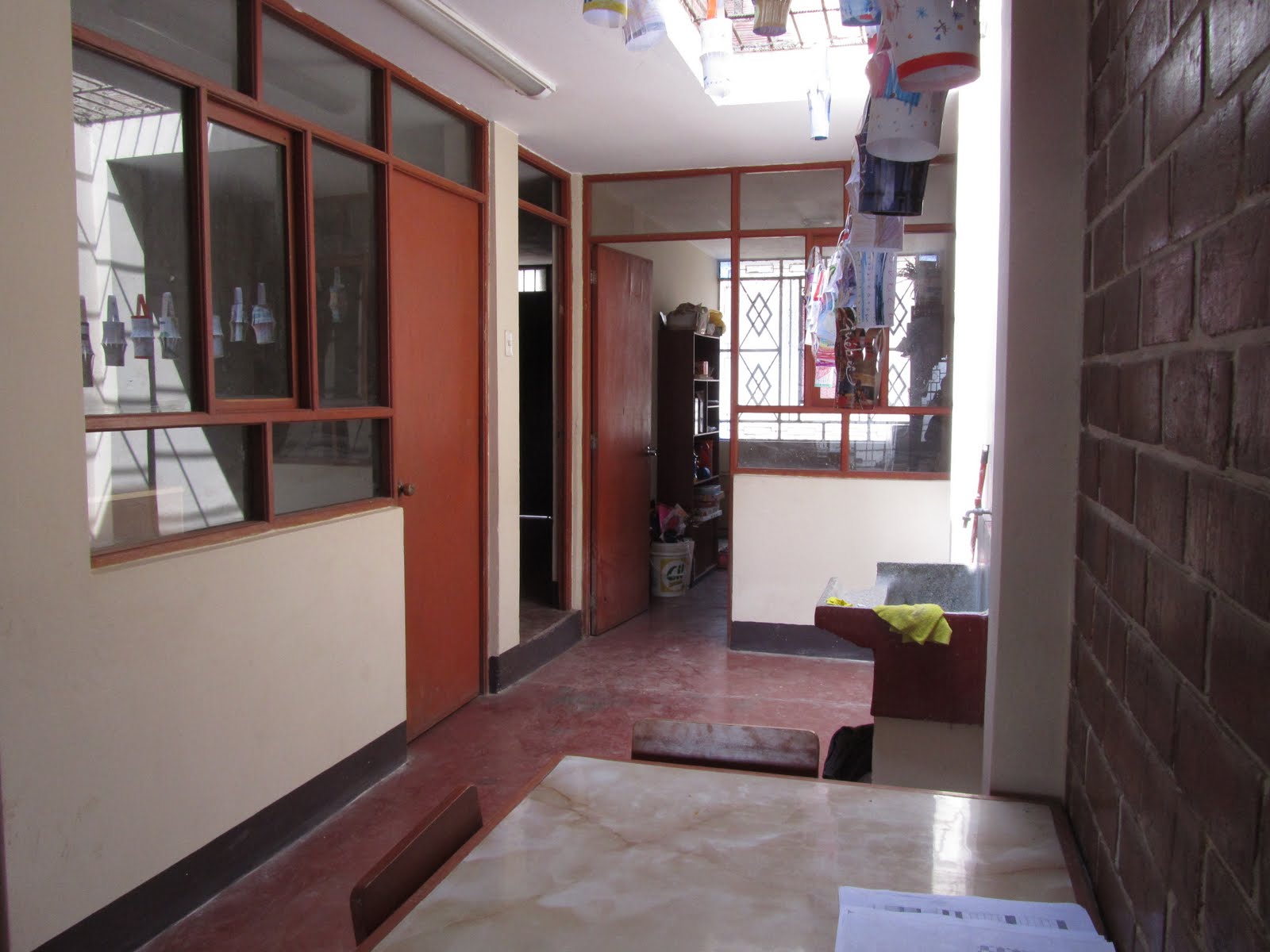
Hallway in the classroom leading to another classroom, the future computer room, and the "library" (storage room for school and art supplies)

More student art decorating the classroom

Our street

My bed!

Huge kitchen

Patio in the house

All of the volunteers from last week, plus Dina (who cooks for us) and Gonzalo (daytime security guard)
I absolutely love our new place. The house is bright yellow with a black spiral staircase, and the classroom is painted white and purple with red brick inside. The colors are all so great and the neighborhood is better. Our house is now closer to Quince and we don't have to walk past a stoop of drunk guys every time we leave home. The kitchen and bathroom are also HUGE.
Since I seem to be on a streak of posting lots of photos here recently, I included some photos below.




Thursday, October 7, 2010
Lomas de Lucumo


Monday, October 4, 2010
Weekend in Lima


Last Wednesday and Thursday, we took a vacation to Lima. Normally when we visit, we don't get to spend much time there because of the 3 hour combi ride each way. So this time, we decided to stay overnight in a hostel.
We left after lunch on Wednesday and got to Miraflores (a really nice part of Lima where some friends live) by about 3:30. After finding a hostel (only 20 soles per person) and dropping off our stuff, we walked over to the ocean. It was one of the volunteer's first time seeing the Pacific Ocean! We then found a really beautiful restaurant overlooking the water, got seats on the patio outside, and watched the sun set over the ocean. After that we went for Greek food and hung out with friends from Miraflores.
The next day was pretty relaxed. In the morning, we got Starbucks, since coffee shops don't exist in Huaycan, and Indian food. Then, around 3, most of the other volunteers decided to head back to Huaycan, while another person and I stayed in Miraflores. She had lived in Miraflores before, so she caught up with old friends, while I went on a search for English books. I've been out of reading material for a while, so I was really excited to find two really good books, both by Latin American authors.
I bought Blindness by Jose Saramago (a Portuguese author who won the Nobel Prize in Literature), and The War of the End of the World by Mario Vargas Llosa (a famous Peruvian author and now politician). I'm now reading Blindness, which is really good so far. But I want to read it in Spanish in the future, because I can tell that it would be absolutely beautiful. And I can't wait to start on The War of the End of the World because I've already read and loved one of Vargas Llosa's books, and this is known as his literary masterpiece.
And that was about it. After that, I just met with the other volunteer, hung out with her friends for a while, then headed back with her. The weekend might sound pretty boring, but it was really a welcome change. After staying in Huaycan for a while - where there aren't bookstores, coffee shops, nice restaurants, or any food other than Peruvian food or chifa - it felt really nice to take a "vacation" and be able to relax, watch the sunset, and do things we normally can't.
Friday, October 1, 2010
Election Day
This Sunday, Peruvians voted for the mayors of their districts and regions. Since it's mandatory to vote in Peru, today was absolutely crazy. It seems like all of Huaycan (and Lima!) was out on the streets. The volunteers who commute from Lima to Huaycan every Sunday couldn't get here today because the traffic was at a standstill. And the main intersection of Huaycan was completely clogged up. There were so many cars in it that none of them could move. When I had to cross the street there, I couldn't even go between some cars because they were stopped so close together. Getting to classes today was quite interesting. We left 45 minutes to an hour early for each class. And then we quickly realized that finding combis was impossible and just used motos all day.
Mandatory voting isn't the only way the government reacts to election day. There's also a law in Peru called La Ley Seca, or the Dry Law. It says that alcohol is illegal in Peru 48 hours before the election and 24 hours after. In other words, no alcohol can be served on Friday, Saturday, Sunday, and maybe even Monday. And all discotecas and clubs are closed those days too. The objective is for people to be sober and ready to vote on Sunday. However, I think it's a fairly ridiculous law, since people respond to it by stocking up on alcohol on Thursday and partying throughout the weekend. In fact, it seems like people almost drink more than they normally would just because they're not allowed.
Mandatory voting isn't the only way the government reacts to election day. There's also a law in Peru called La Ley Seca, or the Dry Law. It says that alcohol is illegal in Peru 48 hours before the election and 24 hours after. In other words, no alcohol can be served on Friday, Saturday, Sunday, and maybe even Monday. And all discotecas and clubs are closed those days too. The objective is for people to be sober and ready to vote on Sunday. However, I think it's a fairly ridiculous law, since people respond to it by stocking up on alcohol on Thursday and partying throughout the weekend. In fact, it seems like people almost drink more than they normally would just because they're not allowed.
Thursday, September 30, 2010
Museo de la Nacion


Two weeks ago, we went to the Museo de la Nacion (National Museum) for our volunteer trip. The museum is being renovated, so they only have three exhibits open right now. However, two of them were the best and most important exhibits in the museum, so I don't think I missed out on anything at all. Plus, admission was free because of the construction!
The first exhibit showed Peruvian art through the years, beginning with the very first indigenous art in the country and ending with very current pieces. I really enjoyed this exhibit because it showed so much about Peruvian history. The art progressed chronologically, so we could easily see some of Peru's most important historical events, like the arrival of the Spaniards.
The second exhibit was fairly small. It was a small room with examples of indigenous art from the last century. The art was great, especially this huge colorful mural on one wall. But it didn't show as much about Peru as the other exhibits. All in all, it was a good exhibit.
The third exhibit was my favorite by far, though it definitely wasn't cheerful like the others. It was about the Sendero Luminoso (Shining Path) terrorism in the 1980s and 1990s. This exhibit was really different from the others. Where the others had brightly painted walls, this featured stark concrete walls and no decorations, only the photographs and plaques with historical information. There were 23 rooms, each focusing on a different aspect of the terrorism. (Note that there were 24 large historical plaques entirely in Spanish. I read them all!)
A quick history lesson: Shining Path, less commonly known as the Communist Party of Peru, is a terrorist organization in Peru. It began as a small revolutionary group led by philosophy professor Abimael Guzman. In 1980, it began acts of terrorism, with the aim of using violence to bring down the government, disrupt the economy, and ruin the state's reputation to create a communist government. It initially targeted low level political figures and upper class people, but eventually started killing anyone and everyone. The state's counter-terrorism campaign was equally brutal, since they killed anyone they suspected of having ties to the Shining Path. There was also a Marxist terrorist group at the time called Tupac Amaru (MRTA) that joined in the violence, but it was much less popular and effective and was more short lived. The violence continued from 1980 until about 2000. It's estimated that 70,000 people were killed between the Shining Path and government terrorism. This time was one of the most important events that defined Peru.
Something that seemed so foreign to me at the beginning really resonated with me by the end. Part way through the exhibit, I realized that even though the terrorism happened in the past, anyone close to my age would have lived through and been affected by it. For example, one of my students from conversation club is named Jason and is 23 years old. He had previously said he moved to Huaycan from Ayacucho before, but we then realized that he moved because of the violence since Ayacucho was the beginning and epicenter of the Shining Path terrorism. And Huaycan was actually created during the 1980s because so many people fled to Lima from the inside of Peru, and Lima didn't have the space to accommodate them. In fact, there was an entire room devoted to the creation of and consecutive violence in Huaycan. That was a complete shock to me, since the places in the photographs were ones I probably see every day, and had no idea about the history behind them. And the vast majority of the people in Huaycan are living there because of the terrorism. Though Huaycan is very safe for us now, ten years ago it would have been completely unthinkable to create an NGO in Huaycan because of safety.
I don't mean to make this a sad post. It really isn't. The museum was a great experience for me, and I now understand a lot more about Peru than before. Yes, it was solemn, but in a good way if that's possible.
Subscribe to:
Posts (Atom)